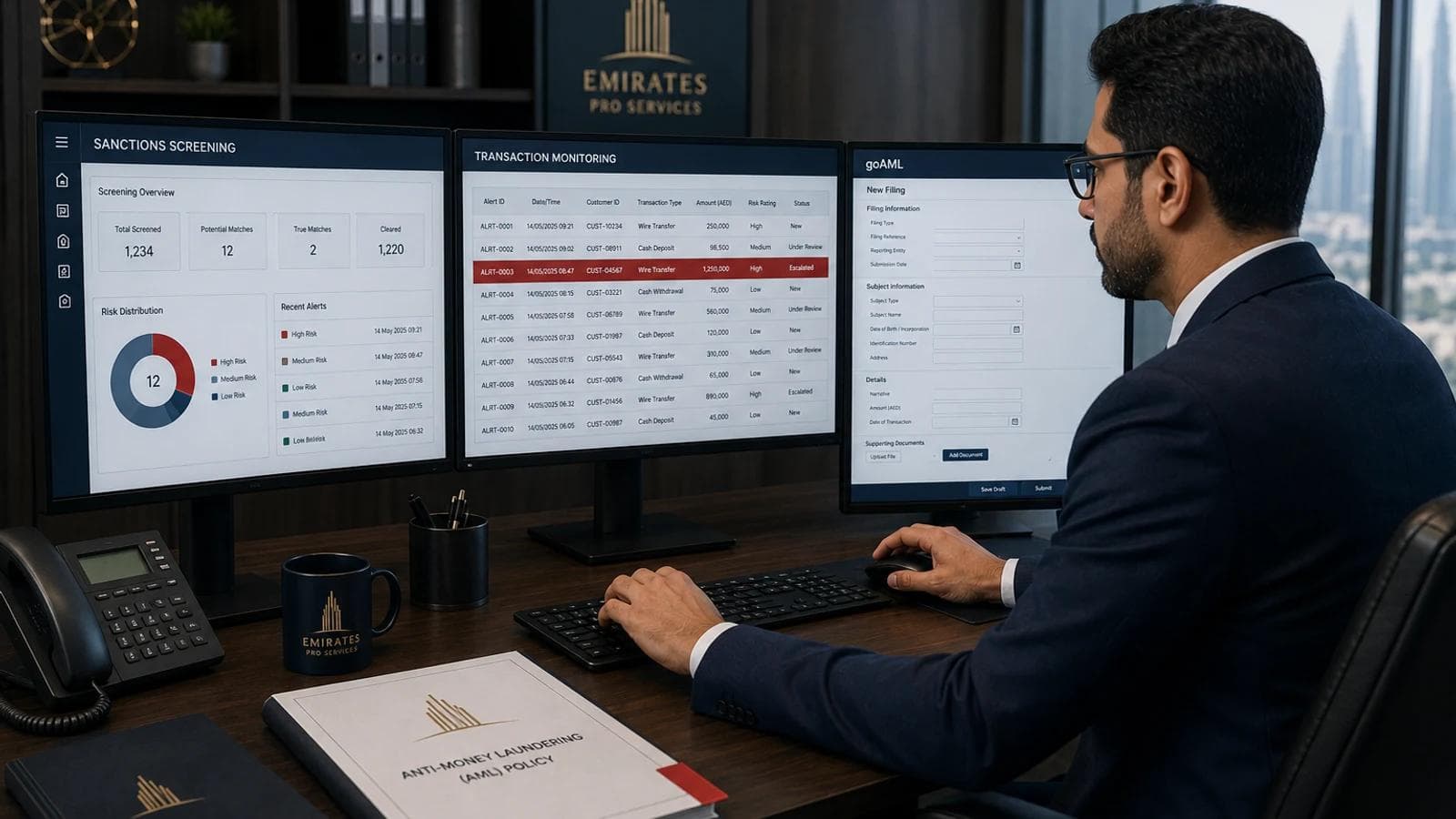
One Governance Framework Over a Stack of UAE Obligations
UAE compliance is now a stack: AML/CFT under Federal Decree-Law No. 10 of 2025 (which replaced Decree-Law No. 20 of 2018), Economic Substance under Cabinet Decision No. 57 of 2020, UBO reporting under Cabinet Decision No. 58 of 2020, sanctions screening and data protection. Avyanco's Risk Advisory practice puts one governance, risk and compliance (GRC) framework over the whole stack, running enterprise risk assessment, controls and monitoring.
UAE compliance is no longer a single obligation — it is a stack. Anti-Money Laundering and Counter-Terrorism Financing under Federal Decree-Law No. 10 of 2025 (which replaced Federal Decree-Law No. 20 of 2018), the Economic Substance Regulations (Cabinet Decision No. 57 of 2020), which applied to the 2019–2022 financial years before being discontinued by Cabinet Decision No. 98 of 2024 for periods from 1 January 2023, Ultimate Beneficial Owner reporting under Cabinet Decision No. 58 of 2020, sanctions screening, data protection under the UAE Personal Data Protection Law, plus Corporate Tax and VAT controls. Handled piecemeal, the obligations overlap, conflict and leave gaps that surface in a regulator review.
Avyanco's Risk Advisory practice puts one governance-risk-and-compliance (GRC) framework over the whole stack. We run the enterprise risk assessment, design the internal controls and policies, map each regulatory obligation to an owner and a control, and build the monitoring that evidences compliance. It complements our dedicated AML programme and ties into the internal audit and Corporate Tax work — so risk, controls and compliance are governed as one system, not a drawer of separate certificates.